

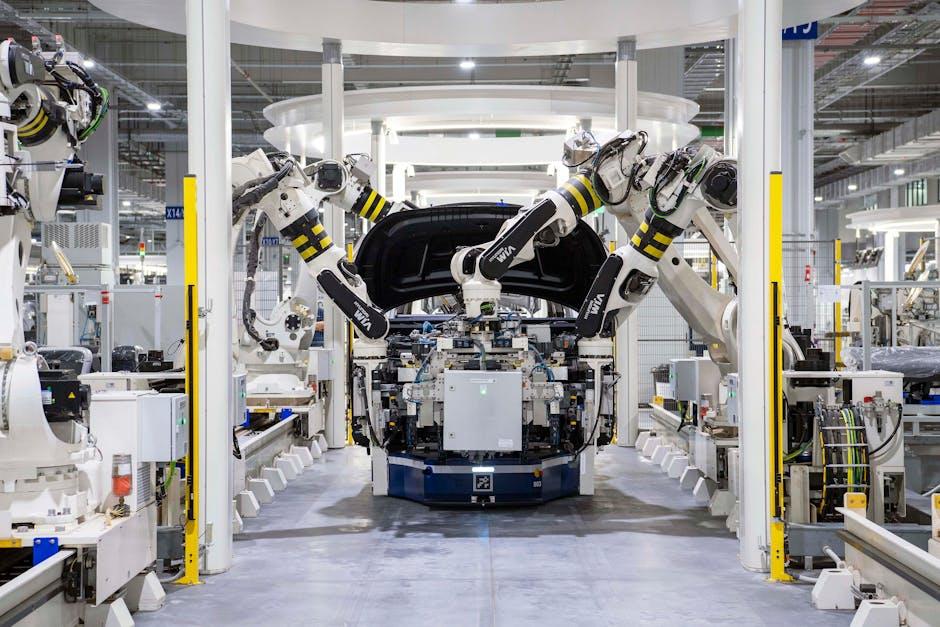
Manufacturers are accelerating investment in automation as labor shortages, cost pressures and supply-chain volatility reshape global production. From robotic arms on assembly lines to AI-driven quality control and predictive maintenance, digital tools are moving from pilot projects to core operations, redefining how factories plan, make and deliver goods.
The shift is as much strategic as it is technological. Executives cite the need for resilience, faster cycle times and consistent quality, while policymakers push for onshoring and cleaner, more efficient plants. Industry groups report record robot deployments and rising adoption of collaborative systems that work alongside people, signaling a broad-based transformation that extends beyond automotive into electronics, food, pharmaceuticals and heavy industry.
The implications are sweeping: productivity and uptime are improving, job profiles are changing, and the competitive gap between highly automated leaders and laggards is widening. As capital flows into smart machinery and software, manufacturers face new questions about cybersecurity, interoperable standards and workforce training-issues that will determine who captures the gains from the next wave of industrial automation.
Table of Contents
- Automation Moves From Islands to Integrated Lines With AI Vision Cobots and Digital Twins
- Manufacturers Close the Talent Gap by Funding In House Reskilling Partnering With Local Colleges and Redesigning Roles
- Leaders Playbook Prioritize High Variability Cells Retrofit Legacy Equipment With Sensors Pilot Predictive Maintenance Segment Networks and Standardize Data Governance
- Future Outlook
Automation Moves From Islands to Integrated Lines With AI Vision Cobots and Digital Twins
Manufacturers are accelerating a shift from standalone robotic cells to end‑to‑end, data‑driven production, as AI‑equipped vision cobots coordinate with material flow, quality, and planning systems through a unified OT/IT backbone; paired with high‑fidelity digital twins, plants are virtually commissioned in days, recipes are validated before steel is cut, and changeovers are simulated to protect takt time-yielding higher OEE, fewer surprises on the floor, and faster payback while addressing labor gaps with assistive automation rather than rigid automation.
- Vision‑guided cobots adapt in real time to part variability, synchronizing with conveyors, AMRs, and palletizers to reduce micro‑stoppages.
- Digital twins mirror the line for virtual commissioning, throughput tuning, and scenario planning, cutting ramp‑up risk.
- Edge AI quality detects defects earlier and auto‑retunes tolerances within governance rules to stabilize yield.
- Unified data layers (OPC UA, MQTT, APIs) link robots, PLCs, and sensors to MES/ERP for closed‑loop scheduling and traceability.
- Predictive maintenance models forecast failures and align service windows with production plans to protect uptime.
- Security‑by‑design with IEC 62443 and zero‑trust patterns safeguards connected assets while scaling pilots to the enterprise.
Manufacturers Close the Talent Gap by Funding In House Reskilling Partnering With Local Colleges and Redesigning Roles
As automation accelerates on the shop floor, manufacturers are pivoting from hiring wars to capability building-funding in‑house academies, co‑designing micro‑credentials with nearby colleges, and redrawing job families to pair machine oversight with human troubleshooting. Executives report faster time‑to‑competency, steadier retention, and broader pipelines from nontraditional talent pools, with unions and workforce boards at the table to ensure portable skills, safety, and measurable productivity gains.
- Funded reskilling at the plant: paid learning hours, tuition assistance, and stackable badges tied to wage steps.
- Local education partnerships: dual‑enrollment pathways, shared robotics/CNC labs, and rapid bootcamps aligned to OEM standards.
- Role redesign: fewer narrow operator slots, more multi‑skilled technicians blending maintenance, data diagnostics, and quality.
- Inclusive pipelines: returnships, language‑accessible curricula, and skills‑based hiring in place of degree screens.
- Metrics that matter: time‑to‑proficiency, scrap reduction, internal fill rates, and safety outcomes tracked alongside output KPIs.
Leaders Playbook Prioritize High Variability Cells Retrofit Legacy Equipment With Sensors Pilot Predictive Maintenance Segment Networks and Standardize Data Governance
As factories race to capture productivity gains from automation, executives are shifting capital to the shop-floor hotspots where variation and unplanned stoppages erode margins, upgrading older assets with IIoT sensors to surface real-time performance signals, and launching narrowly defined pilots to validate predictive maintenance before broader rollouts, while simultaneously hardening operational networks and enforcing enterprise-grade data rules to ensure insights move securely and consistently from machines to dashboards.
- Focus where volatility is highest: Prioritize mixed-model, short-run cells to maximize throughput and OEE uplift per dollar invested.
- Instrument the installed base: Retrofit legacy equipment with vibration, power, and temperature sensors via edge gateways to capture high-fidelity telemetry.
- Prove predictive value fast: Pilot maintenance analytics on critical bottlenecks, with success measured by MTBF, scrap reduction, and schedule adherence.
- Segment and secure OT/IT: Implement zero-trust, microsegmentation, and allow-listed protocols to contain risk and simplify compliance.
- Standardize data governance: Enforce common tag taxonomies, time-series schemas, retention policies, and steward ownership for audit-ready, portable data.
Future Outlook
As factories digitize their lines and link machines to cloud platforms, automation is moving from isolated pilots to the core of manufacturing strategy. Companies cite gains in throughput, quality and traceability, but also confront capital costs, integration hurdles, cybersecurity risks and a widening skills gap. The shift is reshaping supply chains, pulling some production closer to end markets while pushing vendors to prove interoperability and reliability at scale.
Analysts and executives alike say the next phase will be defined less by hardware and more by software, data and talent. Manufacturers that pair collaborative systems with upskilled teams, clear ROI metrics and robust governance are positioning for resilience amid volatile demand and stricter sustainability targets. Standards bodies and policymakers are watching closely, as workforce programs and data rules catch up to factory floors that now operate in real time.
For the sector, the debate has narrowed. The question is no longer whether to automate, but how to do it quickly, securely and profitably.