

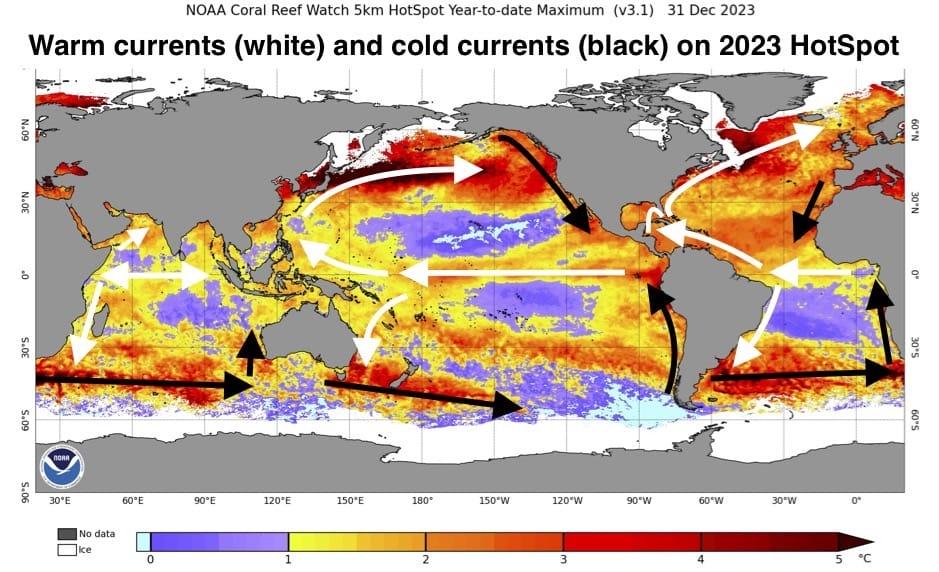
Record-breaking ocean heat is pushing the world’s coral reefs to the brink, triggering mass bleaching on a scale scientists say is unprecedented in modern times. With sea-surface temperatures shattering previous highs for a second consecutive year, the National Oceanic and Atmospheric Administration confirmed a fourth global coral bleaching event in 2024, with damage reported across scores of countries and territories from the Caribbean to the Pacific.
The accelerating loss underscores how climate change, amplified by a strong El Niño, is transforming oceans faster than corals can adapt. Bleaching does not always kill corals, but prolonged heat leaves reefs vulnerable to disease and mortality-erasing ecosystems that shelter a quarter of marine species, buffer coasts from storms, and support livelihoods worth billions. As warming trends intensify, researchers warn the window to save the world’s remaining reefs is narrowing, with survival prospects sharply declining beyond 1.5 degrees Celsius of global warming.
Table of Contents
- Marine Heat Waves Push Coral Reefs Beyond Survival Thresholds
- Bleaching Hotspots Concentrated in the Tropics With Recovery Windows Rapidly Shrinking
- Collapsing Reefs Undermine Food Security Coastal Protection and Local Economies
- Rapid Emissions Cuts and Targeted Local Protections Offer the Best Chance to Save Reefs
- To Wrap It Up
Marine Heat Waves Push Coral Reefs Beyond Survival Thresholds
Weeks-long spikes in sea-surface temperatures are now leaving corals with no recovery window, pushing them from mass bleaching to outright mortality. In many hotspots, thermal stress has exceeded 8-12 Degree Heating Weeks, a threshold long associated with widespread die-off. Field teams report corals expelling their symbiotic algae en masse, followed by tissue loss and infections as heat lingers. Scientists warn that repeated events since 2016, capped by the global bleaching reported in 2023-2024, have eroded resilience: juvenile recruitment is down, energy reserves are depleted, and the intervals between shocks are too short for meaningful rebound.
- Ecological collapse: Keystone builders like Acropora are vanishing, flattening once-complex habitat into rubble fields.
- Food security risks: Reef-dependent fisheries face declining catches and shifting species as nursery grounds degrade.
- Coastal defense weakened: Loss of living reef crests reduces natural wave attenuation, exposing shorelines to erosion and storm surge.
- Tourism revenue hit: Bleached, algae-smothered reefs drive cancellations and cut local incomes.
- Biodiversity loss: Heat-tolerant generalists replace diverse assemblages, shrinking genetic options for adaptation.
Managers are pivoting from restoration optimism to triage. Agencies are deploying heat-stress forecasts to trigger temporary fishing closures, prioritizing herbivore protection and limiting in-water activity during peak anomalies. Emergency tactics-localized shading, selective propagation of heat-tolerant genotypes, and assisted gene flow-remain narrow in scope and cost-prohibitive at seascape scale. Experts say the decisive variable lies upstream: rapid emissions cuts to cool baselines, coupled with strong water-quality controls that suppress compounding stressors. Without both, projections indicate more frequent, longer events that push reefs past physiological thresholds, converting living architecture into carbonate graveyards within a single decade.
Bleaching Hotspots Concentrated in the Tropics With Recovery Windows Rapidly Shrinking
Satellite and in‑water monitoring show heat stress clustering tightly around the equator, with prolonged marine heatwave conditions pushing Degree Heating Weeks (DHW) well into high‑risk territory. Agencies report the fourth global bleaching event on record as alerts escalate across major reef provinces, where nighttime sea surface temperatures have remained 1-2.5 °C above average for weeks. The pattern is consistent: stratified, wind‑stilled waters in the tropical belt are accumulating heat faster than it can be shed, and corals are crossing the threshold from stress to mortality.
- Caribbean-Gulf of Mexico: DHW frequently 8-12; early‑season bleaching from the Florida Keys through the Lesser Antilles and Mesoamerica.
- Eastern Tropical Pacific: Panama-Galápagos corridor with Alert Level 2 in multiple cells and sustained anomalies.
- Western Pacific/Coral Triangle: Parts of Indonesia, Papua New Guinea, and the Solomon Islands registering severe alerts.
- Indian Ocean: Maldives to Seychelles experiencing long, compounding hot spells with weak relief between peaks.
- Great Barrier Reef: Widespread heat stress reported across several sectors, with mass bleaching confirmed by Australian authorities.
The cadence of extreme events is outpacing nature’s repair cycle. Where severe bleaching once arrived a decade or more apart, the return interval has collapsed to 2-5 years in many hotspots-far shorter than the 7-10 years most reefs need to regain cover, complexity, and reproductive capacity. As the “breathers” between heatwaves narrow, compounding stressors are reshaping reef communities and the economies that depend on them.
- Compressed recovery windows: Rebleaching before colonies can regrow tissue or replenish energy reserves.
- Recruitment bottlenecks: Fewer surviving broodstock and heat‑stressed larvae reduce year‑class strength.
- Carbonate budget declines: Slower calcification and erosion tipping more sites into net framework loss.
- Ecosystem services at risk: Knock‑on impacts to fisheries, tourism, and coastal protection as structural complexity fades.
- Management pivots: Expansion of early‑warning networks, targeted shade and cooling trials, and triage protection for heat‑tolerant refugia alongside accelerated emissions cuts debates.
Collapsing Reefs Undermine Food Security Coastal Protection and Local Economies
Food security is tightening across reef-dependent regions as prolonged marine heat triggers mass bleaching, fish habitat loss, and falling catches. Coastal households from the Pacific to the Caribbean report smaller, less predictable landings and shrinking incomes, with nutrition programs warning of reduced access to affordable protein. Fisheries officers say collapsed spawning grounds are pushing boats farther offshore and for longer, raising safety risks and costs while undermining the small-scale sector that supplies local markets.
- Smaller catches and lower species diversity as reef complexity declines.
- Price spikes for staple reef fish, pushing consumers to costlier imports.
- Livelihood strain for artisanal fishers and female fish processors facing reduced throughput.
- Nutrition gaps in island communities where reefs provide a primary source of animal protein.
Coastal protection is weakening in tandem, with flattened reefs offering less natural wave buffering-structures that can reduce wave energy by up to 97% when intact. Engineers and insurers are logging higher erosion rates, recurrent nuisance flooding, and costlier storm recoveries, while businesses tied to snorkeling, diving, and reef-front hospitality see cancellations and closures. Economists warn that compounding losses across fisheries, tourism, and infrastructure are eroding local tax bases and widening fiscal gaps for municipal services.
- Rising flood losses and emergency repair bills as sea states reach farther inland.
- Accelerating beach erosion threatening roads, wells, and nearshore utilities.
- Tourism downturn from degraded dive sites and bleached reefs, with fewer visitor days.
- Insurance pressure via higher premiums and reduced coverage for coastal assets.
Rapid Emissions Cuts and Targeted Local Protections Offer the Best Chance to Save Reefs
Scientists warn that without sharp, near-term emissions cuts, soaring sea temperatures will continue to push corals past their physiological limits. The most effective steps are well known: rapidly curbing climate pollution this decade while scaling clean energy and resilience finance. Policy experts point to measures that can be enacted now to slow thermal stress and buy reefs time for recovery:
- Strengthen national climate pledges with earlier peaking of emissions and clear coal, oil, and gas phaseout timelines.
- End fossil-fuel subsidies and redirect capital to renewables, storage, and grid upgrades in heat‑exposed regions.
- Cut methane and nitrous oxide through leak detection, agricultural reforms, and waste controls to cool the near term.
- Protect blue carbon systems-mangroves, seagrasses, and salt marshes-to lock in carbon and buffer coastal heat.
- Scale climate finance for island and coastal states to deploy reef-safe infrastructure and early-warning networks.
At the water’s edge, targeted protections can reduce local pressures that amplify bleaching and mortality, especially during marine heatwaves. Managers are prioritizing actions with documented benefits for coral survival and post-heat recovery:
- Improve water quality by cutting nutrient and sediment runoff from sewage, farms, and construction sites.
- Strengthen fisheries rules to safeguard herbivores that keep algae in check after bleaching.
- Expand and enforce MPAs, including no‑anchor and no‑take zones around heat‑tolerant reef refuges.
- Rapid-response stewardship: crown‑of‑thorns control, temporary tourism closures, and shading or flow‑enhancement trials where feasible.
- Selective restoration using locally adapted corals and stress‑resilient strains, guided by real-time heat forecasts.
To Wrap It Up
As marine heatwaves intensify and bleaching events stack up, the consequences are moving beyond ecology to economics and security, reshaping coastlines and testing the resilience of communities that rely on reefs for food, jobs and storm protection. Restoration projects and local protections are expanding, but researchers caution that such efforts cannot keep pace without broader reductions in heat stress.
Monitoring networks will track the next warm season closely, with updated assessments expected in the months ahead. For policymakers, the choices are narrowing: how quickly to curb emissions, how to finance adaptation in vulnerable regions, and how to manage fisheries and tourism as habitats degrade.
What happens next will be measured in degrees and days above critical thresholds. For now, the world’s reefs remain on the front line of a hotter ocean-an early signal of the costs of inaction, and a test of how quickly science, policy and public will can converge.